Latest News

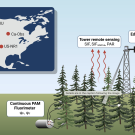
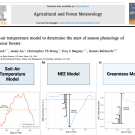
How can tower-based remote sensing track short term stress in grapes? New paper from Chris Wong

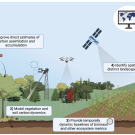
Frequent drought and high temperature conditions in California vineyards necessitate plant stress detection to support irrigation management strategies and decision making. Remote sensing provides a powerful tool to continuously monitor vegetation function across spatial and temporal scales. In this study, we utilized a tower-based optical-remote sensing system to continuously monitor four vineyard subplots in California’s Central Valley.

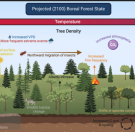
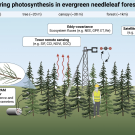
New paper from NASA ABoVE project investigates seasonality of vegetation indices, SIF and GPP

Remote sensing can help us better understand plants' role in the global carbon cycle. In particular, a small light signal emitted by plants during photosynthesis, known as solar-induced chlorophyll fluorescence (SIF), is a promising remotely sensed proxy for carbon uptake due to its strong relationship with gross primary productivity (GPP, ecosystem carbon assimilated during photosynthesis) when observed by satellite.

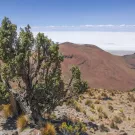
Mili and Mukund publish paper reconstructing hydroclimate variability from oxygen isotopes in tree rings

Understanding past climatic changes in the Central Andes in tropical South America is of great importance to contextualize current hydroclimatic conditions. Here, we present the first P. tarapacana tree-ring stable oxygen isotope (δ18OTR) chronologies and analyze their value as environmental records for this region. Locally known as queñoa, P. tarapacanagrows in the South American Altiplano from 16°S to 23°S at very high elevations (up to 5,100 m a.s.l), making it the highest elevation tree species worldwide. We analyze P.

Plant Optics Lab to present 13 talks/posters at AGU

Mukund, Chris, Jessie, Erica, Jenny, Logan and Devin + other collaborators will all be giving a presentation at the upcoming American Geophysical Union meeting in New Orleans. Check out the list of all talks here!

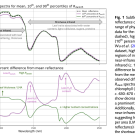
Chris Wong's paper on remote sensing of tree-ring width published

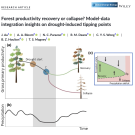
Highlights •GPP, NDVI, NIRv, CCI and SIF products were evaluated in Sierra Nevada conifers. •Relationships with tree-ring width improved upon consideration of a legacy effect. •MODIS GPP best reflected the interannual variation of tree-ring growth. •Site-specific environmental factors are also important considerations. Abstract

Carbon uptake and tree growth are important factors for assessing productivity and long-term carbon storage.

Chlorophyll fluorescence illuminates plant function

News article from PHYS ORG https://phys.org/news/2021-08-chlorophyll-fluorescence-illuminates-func…;

---------

Chlorophyll, the green pigment found in plants and algae, emits faint red and far-red light when illuminated during photosynthesis. This so called chlorophyll-a fluorescence conveys information about the instantaneous rate of photosynthesis, which provides an "optical window" that tracks plant functional and health status.

Lab participates in virtual UC Davis Picnic Day!


On 17 Apr 2021, the UC Davis Annual Picnic day went virtual, and our lab created a video to explain our research to a broad range of viewers. Additionally, we won the Silver (Web) Surfer award which is given to the exhibit that best showcases something amazing in science and technology!

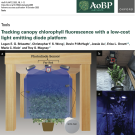
Modification to a gas-exchange system to measure passive and active fluorescence simultaneously

Work led by recently graduated M.S. student, Eliot Meeker! 

Eliot W Meeker, Troy S Magney, Nicolas Bambach, Mina Momayyezi, Andrew J McElrone, Modification of a gas exchange system to measure active and passive chlorophyll fluorescence simultaneously under field conditions, AoB PLANTS, Volume 13, Issue 1, February 2021, plaa066, https://doi.org/10.1093/aobpla/plaa066

New paper on the co-variation of photosynthesis and chlorophyll fluorescence across scales

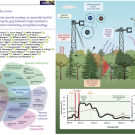
When exposed to light, plants re‐emit a small amount of light from chlorophyll molecules called fluorescence. Remote sensing instruments are now capable of measuring chlorophyll fluorescence (which is emitted between 650–850 nm) from canopies to the globe (solar‐induced chlorophyll fluorescence; SIF). A growing number of papers have highlighted an empirical linear relationship between SIF and whole‐ecosystem photosynthesis (gross primary productivity; GPP).

Arts & Crafts at AGU

Lab members attending the annual American Geophysical Union meeting created cartoon images of themselves for the meeting. Here we are! #AGYou

The lab attends 'virtual' AGU!

Jessie, Erica, Chris and Troy all presented research at the annual American Geophysical Union meeting this week. Lots of interesting talks, and a full list of lab members contributions in the photo.